Hey, it's Pam!
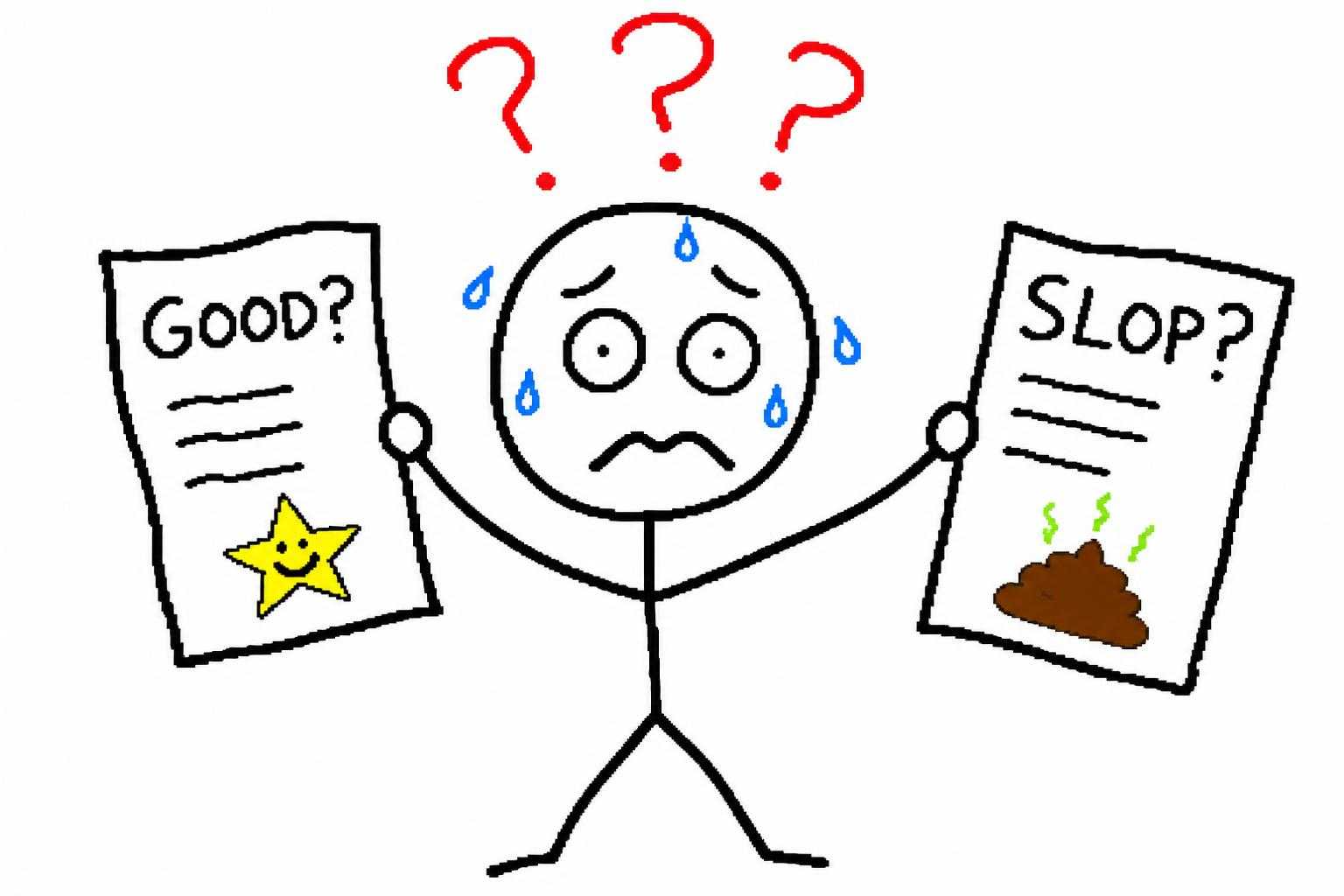
With AI, every draft now arrives looking finished, but this is a much bigger problem than you'd think. This week's edition is about how to tell a good document from a bad one, even if both look polished.
Speaking of documents that look fine and aren't: our next webinar is about de-risking your documentation. If you work in a regulated industry, this webinar is for you! Save your seat here.
📅 Wednesday, August 26, 2026
🕚 11:00 AM–12:00 PM ET In this issue: - Your team produces documents, but if they're using AI, they may not be able to tell a good one from a bad one.
- When documentation passes review, but still doesn't work
-
Copy makeover: an SOP that never says when to clean
|
|
|
|
Your team produces documents, but if they're using AI, they may not be able to tell a good document from a bad one. |
We're living in a world of AI slop, where the assumption is that documents written using AI are well written. That assumption is the problem. Being able to detect what's well written and what's not matters now more than ever, and it's exactly the skill that erodes when it's not exercised.
The foundations of effective writing have not gone by the wayside. Ask a team why a report is rejected again and again and you'll find out fast whether those foundations are still there.
Which is why we built PAM, our Professional Authoring Model, to teach what it works. ChatGPT, Claude, and Grok rewrite based on what they scraped from the internet, which may or may not be correct, and they do it silently. PAM is built on the principles of readability, what the research actually tells us about how readers read, and it shows you the reasoning behind every rewrite. You get the document and you keep the skill. There are no prompts to write, either. PAM asks five questions from a drop-down; easy questions that force the strategic thinking most writers skip. |
|
|
|
How Genentech Rocked Their Written Communication |
Genentech's project management group knew their role required strong written communication. So they searched for training that treated writing as problem solving, not grammar correction. They brought us in for a series of customized workshops built around their own documents and real on-the-job writing.
The result: their team learned how to analyze their readers before drafting, cut unnecessary language, and critically edit before sending.
As Brigitte Keon, their Global Project Manager, put it: "Pam's passion for the subject was apparent." Pam Hurley, PhD, who led the workshops, also developed several other customized workshops for the team.
Want that kind of change for your team? |
|
|
|
The Good, the Bad, and the Ugly: Copy Makeovers |
An SOP that never says when to clean |
Each issue, we create a sample of regulated-industry writing and show how a few changes make it clearer.
Original
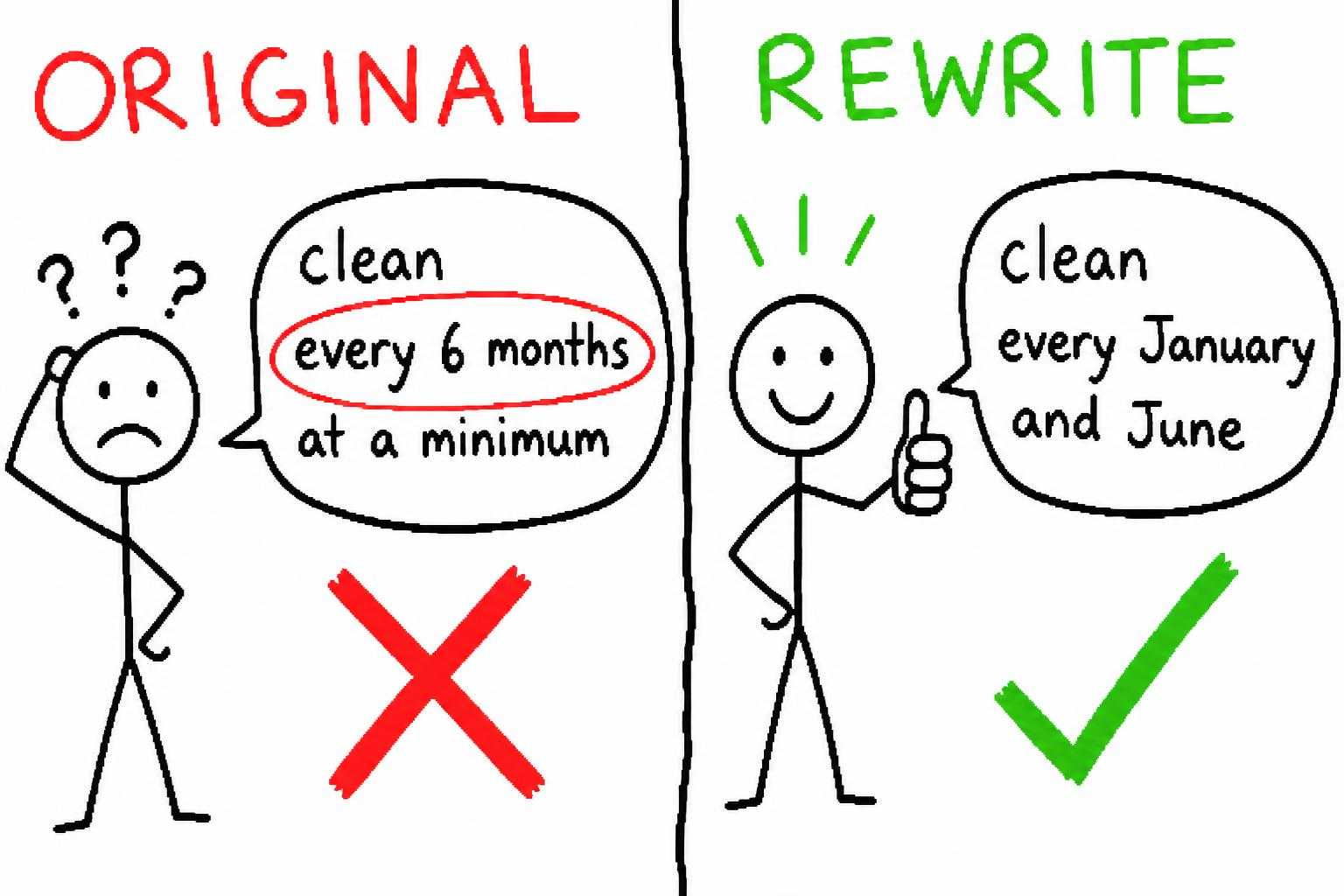
Investigation in all the aforementioned missed cleaning entries found that the language used in SOP-57 to outline routine cleaning is poorly worded. The SOP states that cleaning is "recommended every 6 months at a minimum." This is deemed to be not sufficiently specific. Furthermore, there is a direction for the analyst to coordinate with IT to disable alarms during cleaning. This direction has proved to be a hindrance to initiating cleaning efforts. Recent communications with the administrator revealed that this is not the current practice. It is apparent that a revision of SOP-57 is necessary to align with current practices at our company.
Rewrite SOP-57 is unclear and incorrect, based on our investigation for the following reasons: -
How often cleaning is to be performed should be more specific; for instance, cleaning is to be performed every January and June.
- The SOP states that IT must be contacted to disable alarms; however, the administrator confirms that this is unnecessary.
Recommendations:
1. Rewrite SOP-57 so that it states that cleaning is to be done every January and June. 2. Delete the requirement to coordinate with IT to disable the alarm. Why it works
The original diagnoses the same problem twice. Is the language "poorly worded" or "not sufficiently specific"? Pick one. And "not sufficiently specific" is interpretive anyway: specific enough for whom? "Aforementioned" is legalese. The second half spreads a single point across four clauses, when there is a direction, the direction is a hindrance, the administrator says otherwise, and a revision is apparent all belong in one sentence. Notice the structure, too: problem, then the reason it is a problem, then the recommendation. That order buries the ask and invites wordiness on the way there. The rewrite keeps the same keywords, cuts the redundancy, drops "hindrance" for plain words, and puts the recommendations in a numbered list the reader can act on. |
|
|
|
Thanks for reading!
Don't want to receive these emails? There's an unsubscribe button at the bottom. Copyright © 2026 Hurley Write. All rights reserved.
19701 Bethel Church Rd., Ste 103-144, Cornelius, NC 28031 |
|
|
|
Disclaimer: The documents shown in this newsletter are fictional samples created by Hurley Write for illustrative and educational purposes only. Any names, companies, data, or scenarios depicted are invented and do not represent real clients, organizations, or events. These materials should not be mistaken for, or used as, an actual client's work product. |
|
|
|
|